
Bowhouse
A custom WordPress plugin that runs Bowhouse's market traders from first registration to final payment, with a portal for traders and a back office for the events team.
Bowhouse is a food, farming and makers' venue in Fife. It runs regular markets and food weekends, and each event brings in dozens of independent traders: street food vendors, bars, coffee vans and retail stallholders. In partnership with Flintriver, who designed and built their beautiful new website, we built Bowhouse a custom WordPress plugin that handles every stage of a trader's relationship with the venue, with a self-service portal on one side and a back office for the Bowhouse team on the other.

Market management platform
The challenge
Before each market, the Bowhouse team had to work out who was coming and make sure they were allowed to trade. Applications arrived by different routes. Insurance, food hygiene certificates and alcohol licences were tracked by hand, and an expiry date was easy to miss. For a multi-day event someone had to juggle which traders had applied for which days, by pitch type, then invoice each one for the days they’d been given and chase the payments.
Each of those jobs was manageable on its own. The trouble was that they lived in different places, so there was no single record of what had happened with any trader, and every question meant digging through spreadsheets and email threads.
The solution
Traders now register once and keep a profile shaped to their pitch type, so a street food unit records its dimensions, its 16A or 32A electricity supply and the kW rating of its equipment, while a bar records its alcohol details. They upload their insurance, hygiene certificates and licences with expiry dates, and a live checklist shows exactly what’s still missing before they can submit for approval. From there they apply for specific days of upcoming events and pay their invoices by card through Stripe, including from a secure link in the invoice email that works without logging in.
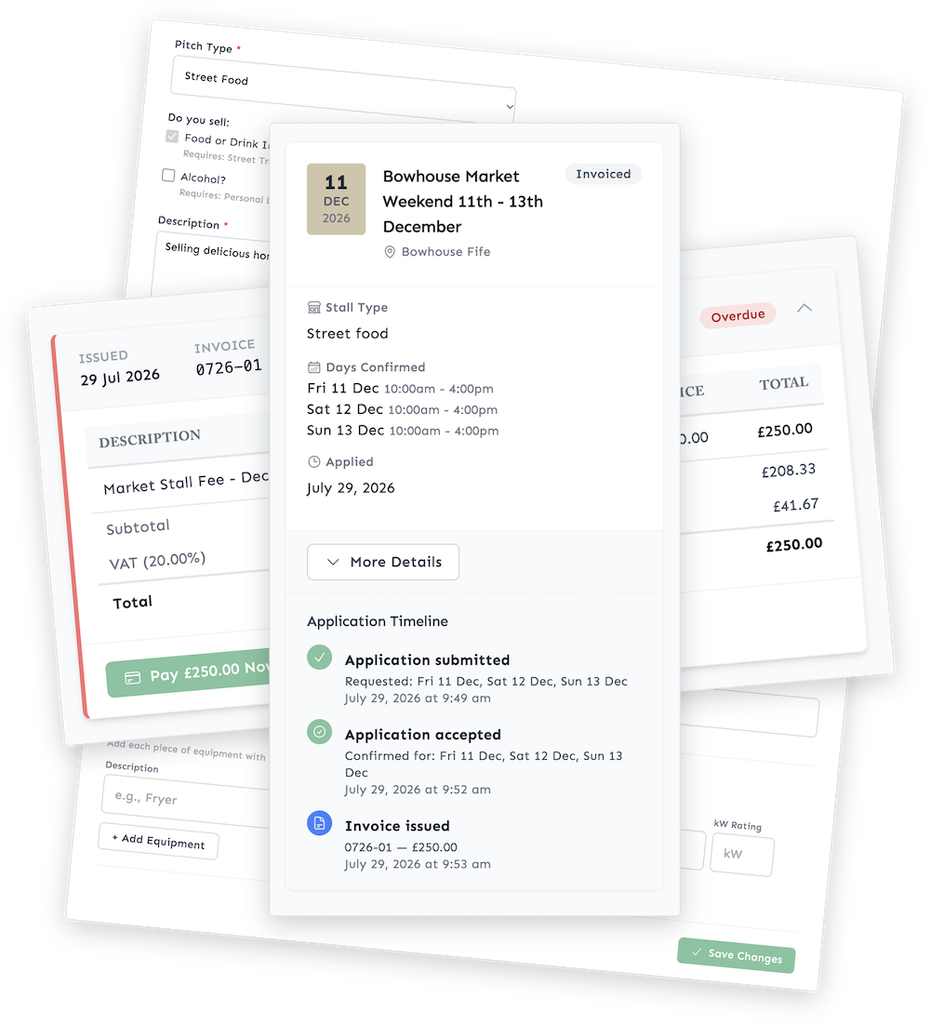
The Bowhouse team selects traders on a grid with one column per event day, toggling the days each trader gets, with the rules for each pitch type built in: street food traders take every day, while retail traders can be booked for single days. Finalising the selection sends each trader the right email, whether that’s a full acceptance, an acceptance for some of their days or a polite decline. Invoices are calculated from the days booked, with VAT, and scheduled jobs send the reminders for expiring documents, unpaid invoices and upcoming events. Every profile edit, upload, application, email and invoice lands on a single timeline for each trader.

The outcome
One system has replaced the spreadsheets, email threads and manual invoicing. Traders register, keep their documents current, apply and pay without contacting the team, and the team can select traders for a multi-day weekend in minutes, with the emails going out automatically.
For the Bowhouse team, the biggest change is where their time goes. Most of the admin that used to fill the weeks before a market now runs by itself, which leaves more time for planning the events. Compliance is easier to stand behind, because expiring documents are flagged before they become a problem, and every invoice matches what the trader booked. With a full history for each trader, the team has the record it needs when a question comes up and when it plans the next event.